
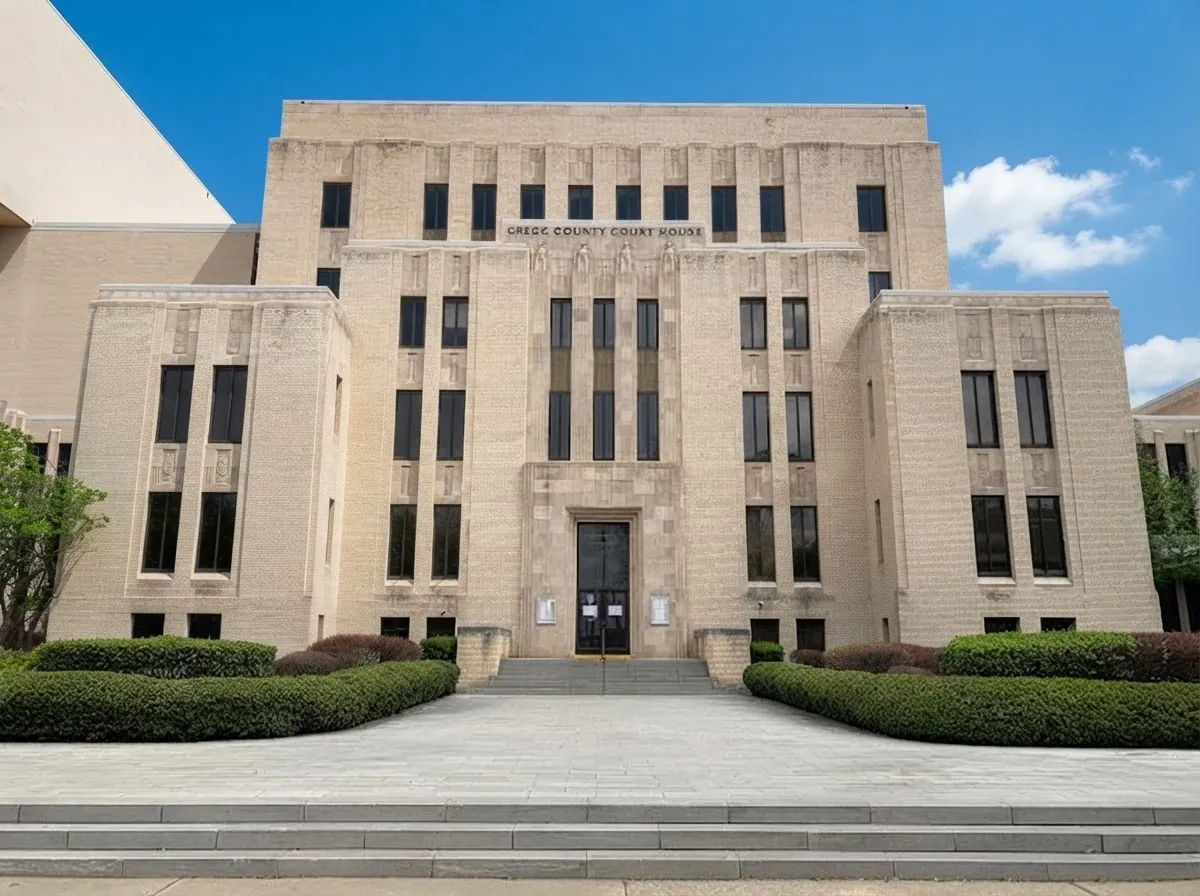
Court records in Gregg County, Texas, are maintained by the district clerk and the county clerk and can be accessed through online tools, official court portals, and the clerks' offices. GreggCourt.us can help you find publicly available court record information for Gregg County. You can also search records through the Gregg County District Clerk's office, the County Clerk's office, and statewide portals such as eFileTexas.gov.
Gregg County Court System Overview
Gregg County is home to three district courts — the 124th, 188th, and 307th Judicial District Courts — all based at the Gregg County Courthouse in Longview. The 124th and 188th District Courts serve Gregg County exclusively, while the 307th also serves Gregg County. In addition to these district courts, Gregg County has county courts that handle misdemeanor criminal cases, civil matters within their jurisdictional limits, and probate. The county seat is Longview, and all major court operations are centralized at the courthouse.
Courts Serving Gregg County
District Courts
For docket information and court schedules, visit the Gregg County District Courts page.
District Clerk
County Clerk
Federal Court
Gregg County falls within the U.S. District Court for the Eastern District of Texas. The nearest federal courthouse division handling cases for this area is located in Marshall, Texas.
Municipal Courts
Cities within Gregg County operate their own municipal courts for Class C misdemeanors and city ordinance violations. These include municipal courts in Longview, Kilgore, Gladewater, and other incorporated cities.
What Types of Cases Gregg County Courts Hear
Gregg County courts handle a wide range of case types across the district and county court levels:
- Criminal: Felonies, misdemeanors, and infractions
- Civil: Lawsuits, contract disputes, personal injury, and other civil litigation
- Family Law: Divorce, child custody, child support, paternity, protective orders, and termination of parental rights
- Probate: Wills, estates, guardianships, and conservatorships
- Juvenile: Delinquency proceedings and child protective cases
- Traffic: Traffic violations and related offenses
- Small Claims: Lower-value civil disputes handled at the justice court level
District Court Cases in Gregg County
The three district courts in Gregg County hear felony criminal cases, civil cases where the amount in controversy exceeds the county court's jurisdictional limit, and family law matters including divorce and custody. The 124th and 188th District Courts handle felony criminal cases under a standing pre-trial order that governs case management. Civil cases above $200 in controversy (with no upper limit) may be filed in district court. Cases are assigned to one of the three courts, and each district judge presides over matters on their own docket. Appeals from lower courts and post-conviction proceedings such as writs of habeas corpus are also heard at the district level.
Magistrate Court Cases in Gregg County
In Texas, the term "magistrate" refers to a function rather than a separate court. Judges at multiple levels — including district judges, county judges, and justices of the peace — serve as magistrates. In Gregg County, justices of the peace and the county court at law handle:
- Class A and Class B misdemeanors (county court at law)
- Class C misdemeanors (justice courts and municipal courts)
- Felony examining trials and magistrate warnings
- Civil cases up to $200,000 (county court at law) and up to $20,000 (justice courts)
- Small claims up to $20,000 (justice courts)
- Traffic violations
- Eviction proceedings
Justice courts also handle truancy cases and may issue search and arrest warrants in their magistrate capacity.
Family Law, Probate, and Juvenile Matters in Gregg County
Family Law
Divorce, custody, child support, paternity, civil protective orders, and termination of parental rights are handled by the district courts in Gregg County. These cases are filed through the District Clerk's office. Attorneys may file electronically through eFileTexas.gov.
Probate
Probate matters — including decedent estates, guardianships, conservatorships, and trust disputes — are generally handled by the county court or county court at law in Gregg County. Probate filings go through the County Clerk's office. Marriage licenses are also issued by the County Clerk; for state-level verification of marriage or divorce records, contact Texas DSHS Vital Statistics or visit Texas Vital Records.
Juvenile
Juvenile cases in Gregg County — including delinquency proceedings and child protective matters — are heard in a designated juvenile court. Juvenile records are confidential under Texas Family Code and are not available to the general public. Contact the District Clerk's office for procedural questions about juvenile matters.
How Cases Move Through the Gregg County Court System
- Filing / Initiation: Criminal cases begin with an arrest or grand jury indictment. Civil cases start when a plaintiff files a petition. Family law cases are initiated by filing a petition (e.g., for divorce or custody).
- Assignment to Judge: Cases are assigned to one of the district courts or to the county court at law, depending on case type and jurisdiction.
- Initial Hearings: In criminal cases, the defendant appears for arraignment. In civil and family cases, the court sets a scheduling conference or temporary hearing.
- Pre-Trial Phase: Parties exchange discovery, file motions, and engage in plea negotiations (criminal) or settlement discussions (civil).
- Trial or Resolution: Cases proceed to trial (jury or bench), or resolve through a plea agreement, settlement, or default judgment.
- Post-Judgment: Criminal cases move to sentencing and possible appeal. Civil cases may involve enforcement of judgments or appeals to the Twelfth Court of Appeals in Tyler.
Court Administration, Local Rules, and Public Access in Gregg County
The district courts in Gregg County operate under the administrative oversight of the regional presiding judge and the local administrative district judge. Day-to-day court administration is coordinated through each court's staff and the District Clerk's office. Local rules and standing orders — including the standing pre-trial order for felony criminal cases — are available through the Gregg County District Courts page.
Public Access to Records
Under the Texas Public Information Act, most court records are generally open to the public. Gregg County has published its open records policy outlining how to submit public information requests. Certain records — including juvenile records, sealed cases, and some family law documents — may be restricted by statute.
Attending Hearings
Court hearings in Gregg County are generally open to the public. Some proceedings may be available remotely; contact the specific court division for current procedures. The Gregg County website provides contact information for each department.
Court Records and Related Court Resources in Gregg County
- Electronic Filing and Case Search: Attorneys and parties can file documents and search cases through eFileTexas.gov, the official e-filing system for Texas courts.
- District Clerk Records: The Gregg County District Clerk maintains records for all district court cases, including civil, criminal, and family law filings.
- County Clerk Records: The Gregg County County Clerk maintains records for county court cases, probate, marriage licenses, and recorded documents.
- Texas Judicial Branch: The Texas Courts website provides statewide court information, rules, and resources.
- Criminal History Search: The Texas DPS Criminal History Name Search allows public searches of Texas criminal records. Additional services are available through DPS Crime Records Services.
- Inmate Information: The Texas Department of Criminal Justice offender search provides location, offense, and release date information for state inmates.
- Sex Offender Registry: The TDCJ offender search page also links to the Texas sex offender registry for public searches.
- Gregg County Sheriff / Jail: The Gregg County Sheriff's Office handles jail-related inquiries at 903-236-1755.
- Vital Records: For birth, death, marriage, and divorce verification, visit Texas Vital Records or the DSHS marriage and divorce records page.
- Public Information Requests: For DPS records, submit requests through the DPS Public Information Requests page.